Contents:
- 35 North American Wildflowers: A Complete Visual and Growing Guide
- Prairie and Meadow Wildflowers
- Woodland and Shade Wildflowers
- Wetland and Riparian Wildflowers
- Desert and Dry-Climate Wildflowers
- Coastal and Shoreline Wildflowers
- Additional Notable Wildflowers
- Quick Comparison: Native Wildflowers vs. Common Garden Lookalikes
- Regional Guide: Which North American Wildflowers Grow Where
- Northeast and New England
- The South and Gulf Coast
- The Great Plains and Midwest
- Rocky Mountains and High Desert
- Pacific Coast and California
- How to Choose the Right North American Wildflower for Your Space
- Frequently Asked Questions About North American Wildflowers
- What are the easiest north american wildflowers to grow from seed?
- Which native wildflowers are safe to grow around pets?
- How are native wildflowers different from invasive wildflowers?
- Can north american wildflowers grow in containers on a balcony?
- When is the best time to plant native wildflowers?
- Start Small, Plant Native
North America is home to more than 17,000 native wildflower species — more floral diversity than all of Europe combined. Yet most people can name fewer than five. That’s a staggering gap between what’s growing in meadows, prairies, and forests across the continent and what most of us actually recognize. Whether you’re tending a balcony container garden in a Brooklyn apartment or trying to ID what’s blooming along a Colorado hiking trail, knowing your native wildflowers changes the way you see the landscape entirely.
This guide covers 35 of the most distinctive and beloved north american wildflowers, organized by type, with regional notes, growing details, and honest comparisons to commonly confused lookalikes. By the end, you’ll have a real working knowledge — not just a list of pretty names.
35 North American Wildflowers: A Complete Visual and Growing Guide
Prairie and Meadow Wildflowers
-
Purple Coneflower (Echinacea purpurea)
One of the most recognizable wildflowers in North America, the purple coneflower blooms from June through August with drooping lavender-pink petals surrounding a spiky orange-brown center cone. Native to the central and eastern US, it thrives in USDA Hardiness Zones 3–9. Plants reach 2–4 feet tall and attract monarch butterflies and goldfinches. Often confused with black-eyed Susan, but the cone is distinctly raised and prickly — black-eyed Susan has a flatter, softer center. Drought-tolerant once established, it’s a staple of Midwest prairie restorations and does surprisingly well in large containers (12-inch pot minimum).
-
Black-Eyed Susan (Rudbeckia hirta)
Bright yellow daisy-like petals around a dark brown dome make this one of the most cheerful wildflowers in the eastern and central US. It blooms from June to October and grows 1–3 feet tall in Zones 3–9. A biennial or short-lived perennial, it self-seeds prolifically, which makes it excellent for naturalized areas. The Maryland state flower, it’s commonly found along roadsides and open fields. Unlike the purple coneflower (a frequent mix-up), its center is softer and more dome-shaped. In the South, it blooms earlier — often by late May in Georgia and the Carolinas.
-
Blazing Star / Liatris (Liatris spicata)
Tall, feathery spikes of bright magenta-purple rise 2–5 feet in late summer, making blazing star one of the most dramatic native prairie plants. It blooms from the top of the spike downward — unusual among flowering plants. Native to the eastern US and Great Plains, it grows in Zones 3–9 and handles both drought and clay soil. Pollinators go absolutely wild for it; studies show it attracts up to 40 species of bees and butterflies. It also makes an exceptional cut flower and looks stunning in a tall vase.
-
Wild Bergamot (Monarda fistulosa)
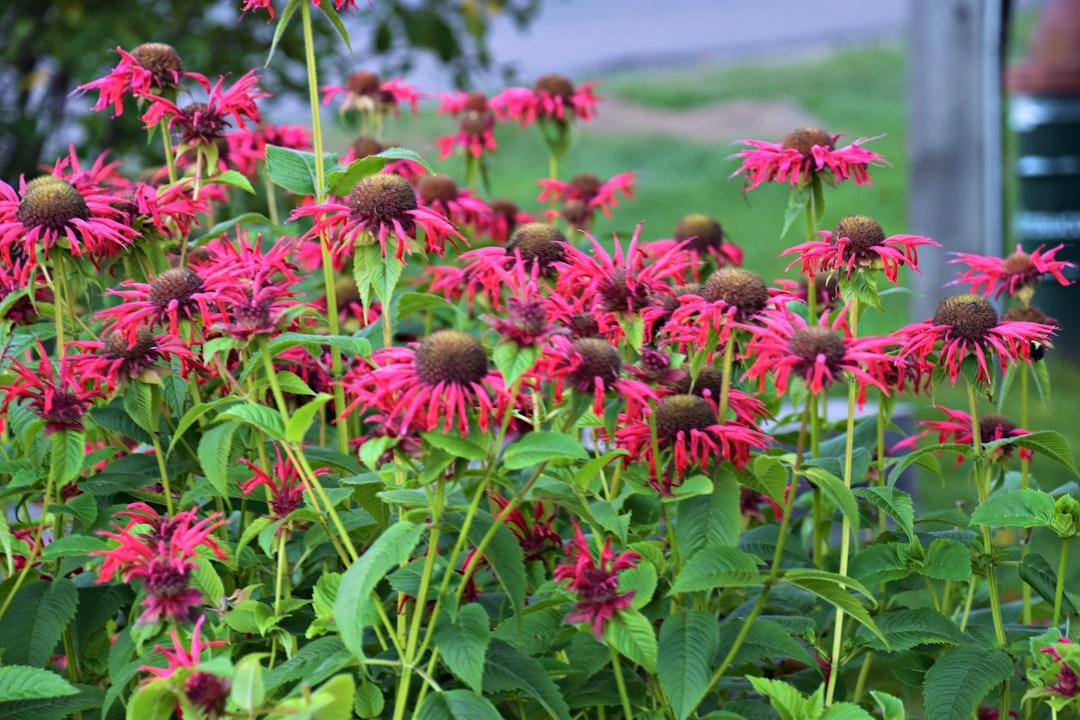
A member of the mint family, wild bergamot produces lavender-pink, spiky blooms from July through September on plants 2–4 feet tall. It’s native to much of North America except the Pacific Coast and grows in Zones 3–9. The leaves have a pleasant oregano-like scent when crushed — early settlers used them to brew tea. Hummingbirds and bumblebees are its primary pollinators. It spreads by rhizome, so in small gardens, divide it every 2–3 years to keep it contained. Don’t confuse it with bee balm (Monarda didyma), which has red flowers and prefers moister conditions.
-
Prairie Smoke (Geum triflorum)
Before it fully blooms, prairie smoke looks like something from a fantasy novel — feathery pink seed plumes that billow in the wind, giving it its name. The actual flowers are small and reddish-nodding, blooming April through June. Native to the northern Great Plains and Rocky Mountain foothills, it grows just 6–12 inches tall in Zones 3–7. Perfect for rock gardens or the edge of a sunny balcony container. It’s one of the earliest native wildflowers to emerge in spring and one of the few that looks even better after it goes to seed.
-
Indian Paintbrush (Castilleja spp.)
The fiery red-orange “flames” of Indian paintbrush are actually modified leaves called bracts — the true flowers are small and greenish, tucked inside. More than 200 species exist across North America, concentrated in the West. Wyoming’s state flower, it’s a hemiparasite that attaches to the roots of neighboring grasses to steal nutrients, which makes it difficult to grow in isolation. In the wild, it carpets alpine meadows and high desert plateaus from April through August. Zones 4–8. It’s essentially impossible to transplant; grow from seed directly in its intended location with a grass companion.
-
Wild Lupine (Lupinus perennis)
Spires of violet-blue pea-shaped flowers bloom May through June on plants 1–2 feet tall. Wild lupine is the sole larval host plant for the endangered Karner blue butterfly, making it ecologically critical in the Northeast and Great Lakes region. It grows in Zones 3–8, prefers sandy, well-drained, acidic soil, and fixes nitrogen — actually improving poor soils over time. The West Coast has its own spectacular species (Lupinus nootkatensis and others) that paint entire hillsides purple in spring. Don’t eat the seeds — they contain toxic alkaloids.
-
Goldenrod (Solidago spp.)
Goldenrod has an undeserved reputation as a hay fever villain — the actual culprit is ragweed, which blooms simultaneously. Goldenrod’s pollen is too heavy and sticky to blow in the wind; it’s bee-transported. Over 100 native species exist in North America, blooming July through October in brilliant gold plumes 1–5 feet tall. It’s one of the most important late-season nectar sources for migrating monarchs. Zones 3–9. In the Northeast, stiff goldenrod (S. rigida) is especially showstopping along roadsides in September.
-
Butterfly Weed (Asclepias tuberosa)
Brilliant orange clusters bloom June through August on compact 1–2 foot plants — one of the few milkweeds without milky sap. A critical monarch butterfly host plant, butterfly weed grows in Zones 3–9 and thrives in dry, sandy, or rocky soils. It’s slow to emerge in spring (sometimes not until late May), so mark its location carefully. Unlike common milkweed, it doesn’t spread aggressively, making it ideal for small gardens or large containers. The flowers also attract hummingbirds and over 20 species of native bees.
-
Wild Columbine (Aquilegia canadensis)
Nodding red-and-yellow flowers with distinctive backward-pointing spurs bloom April through July on delicate 1–3 foot stems. A woodland edge species native to eastern North America, wild columbine grows in Zones 3–8 and tolerates partial shade beautifully. The long nectar spurs evolved specifically to match the bill length of ruby-throated hummingbirds. It self-seeds generously and naturalizes in rocky outcroppings and dry woodland gardens. The Western columbine (A. formosa) has very similar red-and-yellow coloring but slightly different spur structure — a lovely regional counterpart.
Woodland and Shade Wildflowers
-
Trillium (Trillium spp.)
Everything about trillium comes in threes: three leaves, three sepals, three petals. Over 40 species grow across North America, ranging from white (T. grandiflorum) to deep burgundy (T. erectum). They bloom March through May in dappled woodland shade, growing 8–18 inches tall. Zones 4–9. Trilliums are extremely slow-growing — a plant takes 7 years to flower from seed — so never dig them from the wild. They’re legally protected in several states. White trillium is the official wildflower of Ontario, and in the Great Smoky Mountains, spring trillium blooms draw visitors from across the country.
-
Virginia Bluebells (Mertensia virginica)
Clusters of sky-blue trumpet flowers emerge in March and April, then the entire plant disappears by June — a true spring ephemeral. Native to floodplain forests of the eastern US, Virginia bluebells grow 1–2 feet tall in Zones 3–8 and naturalize beautifully under deciduous trees. The buds open pink and shift to blue as they mature, giving a single plant two colors simultaneously. Pair them with hostas or ferns, which fill in after the bluebells go dormant. They’re one of the first wildflowers to feed early bumblebee queens emerging from winter.
-
Wild Ginger (Asarum canadense)
A groundcover rather than a showpiece, wild ginger spreads slowly via rhizome to form dense 6-inch-tall carpets of heart-shaped leaves in Zones 3–8. Its dark reddish-brown flowers hide at soil level under the leaves in April and May — technically present but rarely seen. The leaves smell strongly of ginger when crushed, though it’s unrelated to culinary ginger. Native across eastern North America, it’s one of the best native alternatives to invasive English ivy in shaded urban gardens. Deer-resistant and virtually maintenance-free once established.
-
Bloodroot (Sanguinaria canadensis)
One of the earliest spring wildflowers, bloodroot pushes through leaf litter in March with a single white flower wrapped in a lobed leaf. Blooms last only 1–2 days, but the foliage persists attractively through summer. Native to eastern North American forests, it grows in Zones 3–8. The name comes from the vivid orange-red sap in its roots, used historically as dye and body paint by Indigenous peoples. The double-flowered form (‘Multiplex’) lasts slightly longer. It naturalizes well under oak trees and requires nothing once established except a shaded spot with moist, humus-rich soil.
-
Jack-in-the-Pulpit (Arisaema triphyllum)
Architecturally striking, Jack-in-the-Pulpit features a hooded spathe (the “pulpit”) sheltering a slender spadix (“Jack”) in April through June. Native to moist eastern woodlands, it grows 1–3 feet tall in Zones 4–9. The plant is sequentially hermaphroditic — younger, smaller plants are male; larger, older plants become female and produce clusters of glossy red berries in fall. Toxic if eaten raw, but birds feast on the berries. It’s one of the most fascinating conversation-starters in any native shade garden.
-
Dutchman’s Breeches (Dicentra cucullaria)
Named for the pantaloon-shaped white flowers hanging upside-down from arching stems, Dutchman’s breeches bloom April through May in rich eastern woodlands. Plants are only 6–12 inches tall and go fully dormant by midsummer. Zones 3–7. The flowers are pollinated almost exclusively by long-tongued bumblebee queens, which are the only insects strong enough to push past the petals. Often mistaken for bleeding heart (Lamprocapnos spectabilis), a Asian garden perennial — Dutchman’s breeches are smaller, earlier, and have distinctly different pointed “legs” on the flower.
-
Mayapple (Podophyllum peltatum)
Colonies of umbrella-like leaves 12–18 inches tall carpet the forest floor across eastern North America, but only plants with two leaves produce a single waxy white flower hidden beneath — and later, a small yellow fruit. Zones 3–9. The fruit is edible when fully ripe (and only then — all other parts are toxic). Mayapple spreads aggressively by rhizome, making it ideal as a large-scale groundcover under trees. It goes dormant by late July. Box turtles are among its primary seed dispersers in the wild.
-
Shooting Star (Primula meadia, formerly Dodecatheon meadia)
Swept-back magenta petals and a pointed yellow beak make shooting star look like a tiny comet in mid-flight. It blooms April through June on stems 1–2 feet tall in meadows, open woods, and cliff ledges from the Midwest eastward. Zones 4–8. Like many spring ephemerals, it goes dormant by July. Bumblebees “buzz pollinate” it — vibrating their flight muscles at a specific frequency to shake pollen loose. The South has its own related species, P. frenchii, considered one of the rarest wildflowers in the US.
Wetland and Riparian Wildflowers
-
Cardinal Flower (Lobelia cardinalis)
Spikes of intense scarlet blooms up to 4 feet tall make cardinal flower one of the most vivid native wildflowers in North America. It blooms July through September along stream banks, pond edges, and moist meadows in Zones 2–9. It’s the go-to hummingbird magnet — the flower tube is precisely sized for a hummingbird’s bill, and bees largely can’t access the nectar. It’s a short-lived perennial that self-seeds to replace itself. In the South, it often blooms through October. Perfect for a consistently moist container or rain garden.
-
Blue Flag Iris (Iris versicolor)
Striking blue-violet flowers with yellow and white veining bloom May through July on 2–3 foot stems along pond margins and wet meadows throughout the Northeast and Great Lakes. Zones 3–9. Often mistaken for cultivated bearded iris, blue flag is distinguished by its smooth (non-bearded) falls and its preference for wet feet — it can grow in up to 4 inches of standing water. All parts are toxic if ingested. The similar Western blue flag (I. missouriensis) grows in mountain meadows from the Rockies to the Pacific Coast.
-
Swamp Rose Mallow (Hibiscus moscheutos)
Dinner-plate blooms up to 10 inches across in white, pink, or crimson appear July through September on statuesque 3–7 foot plants along marshes and tidal wetlands of the eastern US. Zones 4–9. Despite its dramatic size, it dies back to the ground each winter and re-emerges late in spring. Its large flowers last only one day, but a mature plant produces dozens of blooms over 6–8 weeks. Ruby-throated hummingbirds visit frequently. In container gardens, choose compact cultivars like ‘Luna’ that top out at 2–3 feet.
-
Rose Pogonia (Pogonia ophioglossoides)
A delicate pink orchid of sphagnum bogs and wet meadows, rose pogonia blooms June through July on single 4–12 inch stems. Native to the eastern US and Canada, it grows in Zones 3–8 in the acidic, nutrient-poor conditions of bog habitats. Each plant produces just one flower. Like most native orchids, it cannot be successfully transplanted — it depends on specific mycorrhizal fungi in the soil. One of roughly 200 native orchid species in North America, many of which are endangered due to habitat loss.
-
Blue Mistflower (Conoclinium coelestinum)
Fuzzy clusters of lavender-blue flowers resembling ageratum bloom August through October, filling the late-season gap when most wildflowers are finished. Native to moist thickets and stream banks in the eastern and central US, it grows 1–3 feet tall in Zones 5–10. Often confused with the annual garden ageratum, but blue mistflower is a native perennial that spreads by rhizome. It’s one of the most valuable late-season nectar sources for migrating butterflies, particularly sulphurs and skippers.
Desert and Dry-Climate Wildflowers
-
Desert Marigold (Baileya multiradiata)
Cheerful yellow blooms on woolly silver stems appear nearly year-round in the Sonoran and Chihuahuan Deserts of the Southwest, with peak bloom in spring and fall. Plants grow 1–2 feet tall in Zones 7–11 and are extraordinarily drought-tolerant once established — surviving on as little as 8 inches of annual rainfall. Unlike the common marigold (Tagetes) sold in garden centers, desert marigold is a true native wildflower with finely divided foliage and a much longer bloom period. It’s toxic to sheep but attractive to native bees.
-
Claret Cup Cactus (Echinocereus triglochidiatus)
Technically a cactus that produces wildflower blooms, claret cup erupts in brilliant scarlet-orange flowers each April and May throughout the Rocky Mountain Southwest. Plants form low mounding clumps 6–12 inches tall in Zones 5–9. The flowers last about a week but are among the most intensely colored of any native plant. Hummingbirds are the primary pollinators. In the wild, claret cup grows on rocky ledges and canyon walls from Colorado to Texas. It handles -20°F winters better than most cacti — a genuinely cold-hardy desert plant.
-
Prickly Poppy (Argemone pleiacantha)
Crinkled white petals surrounding a golden center emerge from a fiercely spiny plant 2–4 feet tall, blooming May through September in the Chihuahuan Desert and dry grasslands of the Southwest. Zones 6–10. The sap is yellow and toxic; grazing animals avoid it entirely. Yet the flowers are genuinely beautiful and attract native solitary bees. Often mistaken for the California poppy, prickly poppy is larger, thornier, and produces white rather than orange blooms. It self-seeds prolifically in dry, disturbed soils.
-
Owl’s Clover (Castilleja exserta)
A California native that carpets hillsides and valley grasslands in pink-purple from March through May, owl’s clover is a hemiparasite like its cousin Indian paintbrush, attaching to the roots of grasses and forbs. It grows 4–16 inches tall in Zones 8–10. In good years, it creates sweeping pink tapestries across coastal ranges and the Central Valley — one of the defining sights of a California super bloom. It’s an annual, so bloom quality varies dramatically with winter rainfall.
-
Farewell-to-Spring (Clarkia amoena)
One of the last native annuals to bloom on California’s coastal hillsides, farewell-to-spring puts on its show of satiny pink-to-lavender flowers in May through July just as the grasslands dry out. Plants grow 1–2.5 feet in Zones 7–10. The flowers have a distinctly tissue-paper texture and often display a deeper pink blotch in the center. Named for the end of the cool, wet season it heralds, it’s exceptional for cutting gardens and naturalizes easily in dry West Coast gardens from seed sown in fall.
-
Rocky Mountain Columbine (Aquilegia coerulea)
Colorado’s state flower, the Rocky Mountain columbine produces large blue-and-white flowers with dramatic 2-inch spurs from June through August at elevations up to 11,500 feet. It grows 1–3 feet tall in Zones 3–8 in well-drained, cool mountain soils. Unlike the eastern wild columbine’s red-and-yellow palette, this species is distinctly blue and white. Hummingbirds and hawk moths pollinate it. It crosses freely with other columbine species, so pure wild populations are increasingly rare near gardens. One of the most elegant mountain wildflowers on the continent.
Coastal and Shoreline Wildflowers
-
Sea Rocket (Cakile edentula)
A succulent annual that colonizes sandy beaches and dunes from Newfoundland to Florida, sea rocket produces small lavender-pink flowers from June through September. It grows just 6–12 inches tall in Zones 3–10 and is one of the few wildflowers adapted to survive salt spray, sand burial, and the wrack zone. The fleshy leaves are edible and taste mildly like arugula. It’s a pioneer species — often the first plant to stabilize newly formed sand accumulations. Not a garden plant, but an important one to recognize along Atlantic and Great Lakes shorelines.
-
Beach Morning Glory (Calystegia soldanella)
Trailing along Pacific Coast dunes from British Columbia to Baja California, beach morning glory produces rose-pink funnel flowers from April through August. It grows just 2–6 inches tall but spreads several feet along the sand. Zones 7–10. Unlike its weedy cousin field bindweed (Convolvulus arvensis), beach morning glory is a well-behaved native with kidney-shaped leaves that’s essential for dune stabilization. It’s one of the few plants that can establish in the foredune zone directly above the tide line.
-
Sea Pink / Thrift (Armeria maritima)
Tight round cushions of grass-like foliage topped with pompom clusters of rose-pink flowers bloom April through June along rocky Pacific and Atlantic coastlines. Plants grow 6–12 inches tall in Zones 3–9. Despite its delicate appearance, sea pink tolerates salt spray, drought, and poor, rocky soils better than almost any other flowering plant. In the Northeast, it’s found on exposed granite headlands in Maine and Massachusetts. On the West Coast, it grows on coastal bluffs from Alaska to California. An ideal plant for a sunny windowsill or balcony railing planter.
Additional Notable Wildflowers
-
Wild Strawberry (Fragaria virginiana)
Small white five-petaled flowers bloom March through June on runners that root as they spread, forming a low groundcover 3–6 inches tall across much of North America. Zones 3–10. The tiny red fruits that follow are intensely flavorful — far more aromatic than commercial strawberries. Wild strawberry is an ideal living mulch under taller native plants and an excellent choice for small-space gardens since it stays compact and edible. It was one of the parent species crossed to create the modern garden strawberry in 18th-century France.
-
Spiderwort (Tradescantia ohiensis)
Three-petaled violet-blue flowers open each morning and close by midday — hence the nickname “dayflower” in some regions. Spiderwort blooms May through July on clumping plants 1–3 feet tall across the central and eastern US. Zones 4–9. Each flower lasts only half a day, but a healthy clump produces dozens of buds over several weeks. The flowers, leaves, and young shoots are all edible. Scientists use spiderwort’s large chromosomes as a model organism in genetics research. The stamens, covered in purple hairs, are particularly beautiful under magnification.
-
Blue Wild Indigo (Baptisia australis)
Spikes of deep blue-purple pea flowers bloom May through June on shrub-like plants that reach 3–5 feet tall and equally wide at maturity. Blue wild indigo is a long-lived native — individual plants can survive 50 years or more — and it fixes nitrogen in the soil. Zones 3–9. It’s slow to establish (takes 3 years to first bloom) but virtually indestructible thereafter. Inflated black seed pods rattle in fall and were historically used as baby rattles. A foundational plant for prairie and meadow restorations across the eastern half of North America.
-
Pasque Flower (Pulsatilla patens)
One of the first wildflowers to bloom each spring — often pushing through snow in March — pasque flower produces silky purple blooms on 4–8 inch furry stems. Native to prairies and open forests from Alaska to Texas, it grows in Zones 4–8. After flowering, it develops feathery, silvery seed heads similar to prairie smoke. South Dakota’s state flower, it’s a symbol of the Great Plains spring. The flowers are strictly cup-shaped when open, unlike similar-looking anemones, which have flatter blooms. All parts are mildly toxic but the plant has a long history of medicinal use by Indigenous Plains peoples.
Quick Comparison: Native Wildflowers vs. Common Garden Lookalikes
| Native Wildflower | Common Lookalike | Key Difference | Wildlife Value |
|---|---|---|---|
| Purple Coneflower (Echinacea) | Black-Eyed Susan (Rudbeckia) | Coneflower has raised, spiky cone; drooping petals | Both high; coneflower seeds feed goldfinches |
| Blue Flag Iris (I. versicolor) | Bearded Iris (hybrid) | Blue flag has smooth falls; needs wet soil | Native iris supports specialist native bees |
| Dutchman’s Breeches | Bleeding Heart (Lamprocapnos) | Smaller; pointed “legs”; forest ephemeral | Critical early bumblebee queen food source |
| Butterfly Weed (Asclepias tuberosa) | Common Marigold (Tagetes) | Milkweed with flat-topped orange clusters | Essential monarch butterfly host plant |
| Beach Morning Glory | Field Bindweed (Convolvulus) | Kidney-shaped leaves; coastal dune habitat only | Native; non-invasive dune stabilizer |
Regional Guide: Which North American Wildflowers Grow Where
Northeast and New England
Spring ephemerals dominate here — bloodroot, trillium, Virginia bluebells, and Dutchman’s breeches put on their best show March through May in deciduous forests. Summer brings cardinal flower along stream banks and blazing star in coastal plain meadows. Goldenrod is the defining fall wildflower of the region, coloring roadsides brilliant gold from Maine to Maryland every September.
The South and Gulf Coast
The South’s longer growing season means wildflowers start earlier and linger later. Black-eyed Susans bloom by late April in Georgia. Swamp rose mallow thrives in tidal marshes from Virginia to Texas. Blue wild indigo is a signature plant of the Piedmont. In Texas, the state claims the bluebonnet (Lupinus texensis) as its own — entire highways are seeded with it each fall for the spring show.
The Great Plains and Midwest
Prairie wildflowers define this region: purple coneflower, wild bergamot, blazing star, and butterfly weed form the backbone of tallgrass prairie restorations across Iowa, Illinois, and Kansas. Pasque flower heralds spring on the shortgrass prairie. The bloom sequence runs from April through October, with something new peaking almost every month.
Rocky Mountains and High Desert
Elevation creates dramatic micro-climates — Rocky Mountain columbine at alpine meadows, claret cup cactus on canyon walls at lower elevations. Indian paintbrush flames red across Wyoming’s mountain slopes in July. Desert marigold blooms nearly year-round in Arizona’s Sonoran Desert lowlands.
Pacific Coast and California
California’s extraordinary diversity — over 6,500 native plant species — means wildflower watching is a seasonal event. Super blooms in drought-recovery years paint hillsides with owl’s clover and goldfields. Farewell-to-spring closes the coastal season in late June. The Pacific Northwest features camas meadows, trilliums, and shooting stars in abundance.
How to Choose the Right North American Wildflower for Your Space
Living in a small apartment doesn’t mean you can’t grow native wildflowers — it means you need to be strategic. A few key questions will narrow your options fast.
How much light do you get? South- or west-facing balconies with 6+ hours of sun open up prairie wildflowers like butterfly weed, black-eyed Susan, and blazing star. Fewer than 4 hours of direct sun? Lean toward woodland species: wild columbine, Virginia bluebells, or wild ginger work beautifully in large pots with quality potting mix.
What’s your USDA Hardiness Zone? This is the single most important number for long-term success. Find yours at planthardiness.ars.usda.gov — it’s determined by your average annual minimum temperature. Most prairie and eastern woodland natives are extremely hardy (Zones 3–6), while desert and coastal species need warmer minimums (Zones 7–11).
Container or in-ground? For containers, choose species that top out under 3 feet: sea pink, wild columbine, prairie smoke, spiderwort, and butterfly weed all perform well in 10–14 inch pots with drainage holes. Avoid aggressive spreaders like goldenrod or mayapple in containers — they need room to roam.
Do you want wildlife value? If attracting pollinators or supporting monarch butterflies is a goal, prioritize butterfly weed (milkweed), wild bergamot, blazing star, and goldenrod. These four together will transform any sunny outdoor space into a pollinator hub from June through October.
Are you buying plants or starting from seed? Many native wildflowers are available as potted plants from specialty native plant nurseries for $8–$15 each. Seeds are cheaper ($3–$8 per packet) but require patience — some species like blue wild indigo and shooting star may take 2–3 years to first bloom. Local native plant society sales are excellent sources of regionally appropriate species, often at lower prices than commercial nurseries.
Frequently Asked Questions About North American Wildflowers
What are the easiest north american wildflowers to grow from seed?
Black-eyed Susan, butterfly weed, wild columbine, and spiderwort are among the most reliable from seed. Sow black-eyed Susan and wild columbine in fall for natural cold stratification; they’ll germinate the following spring. Butterfly weed needs 6–8 weeks of cold stratification in the refrigerator before indoor sowing in late winter.
Which native wildflowers are safe to grow around pets?
Wild strawberry, spiderwort, and wild bergamot are non-toxic to dogs and cats. Avoid trillium, bloodroot, jack-in-the-pulpit, wild lupine, blue flag iris, and pasque flower — all contain compounds toxic to pets if ingested. Always verify with the ASPCA’s plant toxicity database before adding new plants to a pet-accessible space.
How are native wildflowers different from invasive wildflowers?
Native wildflowers evolved in North America alongside local insects, birds, and soil fungi — they support these relationships. Invasive wildflowers (like purple loosestrife, Dame’s rocket, or Queen Anne’s lace) were introduced from other continents and often out-compete natives without providing the same ecological benefits. Always check your state’s invasive species list before planting anything labeled “wildflower.”
Can north american wildflowers grow in containers on a balcony?
Yes — dozens of species do well in containers. The key requirements: containers at least 10–12 inches deep with drainage holes, a quality potting mix blended with 20–30% perlite for drainage, and species matched to your light conditions. Compact native wildflowers like sea pink, wild columbine, prairie smoke, and butterfly weed are particularly well-suited to container growing.
When is the best time to plant native wildflowers?
Fall is the optimal planting time for most native perennial wildflowers — it mimics natural seed dispersal and allows roots to establish during cool, moist conditions before summer heat arrives. Spring planting (April through May) works well too, especially for potted transplants. Native annuals like farewell-to-spring and owl’s clover should be direct-seeded in fall in mild climates or early spring in cold ones.
Start Small, Plant Native
You don’t need an acre of land to make a meaningful contribution to native wildflower conservation. A single pot of butterfly weed on a fourth-floor balcony becomes a monarch waystation. Three containers of late-blooming goldenrod feed migrating pollinators that have no other food source in a concrete neighborhood. The plants